

- Editor

- CategoryEquimotional Wellbeing Coaching
- DateFebruary 26, 2026
- Share
Children with sensory processing difficulties often struggle to find calm in everyday environments. Horses offer something unique: a warm, rhythmic, living presence that helps regulate the nervous system without words or instruction. Discover how Equimotional Wellbeing Coaching at SJ Equine Coaching in Cloonlara uses the horse-human connection to support sensory regulation.
What Is Sensory Processing and Why Does It Matter?
Every moment of every day, your child’s brain is taking in sensory information from the world around them, sounds, textures, lights, smells, movement, temperature, the position of their body in space. For most children, the brain filters and organises this information without any conscious effort. The hum of a classroom, the feel of a school uniform, the brightness of overhead lights — it all gets processed in the background.
For children with sensory processing difficulties, that filtering system doesn’t work the same way. Some sensory inputs come through too strongly. A label on a shirt feels like sandpaper. The noise of a busy canteen is overwhelming. Fluorescent lights feel like a headache waiting to happen. Other inputs don’t register enough, leading the child to seek out more intense sensory experiences like crashing into things, spinning, chewing on objects, needing deep pressure to feel grounded.
Sensory processing difficulties are common in children with autism, ADHD, anxiety, and a range of other neurodevelopmental conditions. They’re not a behavioural choice. They’re a neurological reality, and they affect everything from a child’s ability to concentrate in school to their willingness to try new foods, wear certain clothes, or tolerate being in a crowded room.
What Is Co-Regulation and Why Do Horses Do It So Well?
Co-regulation is the process by which one nervous system helps to calm another. It’s what happens when a parent holds a distressed baby and the baby gradually settles. The parent’s calm breathing, steady heartbeat, and warm body communicate safety to the baby’s nervous system, helping it shift from a state of alarm to a state of calm.
Children with sensory processing difficulties often need co-regulation well beyond the baby and toddler years, because their nervous systems are easily pushed into states of overwhelm or under-stimulation. The challenge is that human co-regulation can be complicated. A parent might be stressed themselves. A teacher might be managing thirty other children. The person offering comfort might inadvertently add more sensory input — talking too much, touching too firmly, being too close.
Horses are remarkably effective co-regulators, and here’s what makes them different from humans:
Their resting heart rate is slow and steady. A horse’s heart beats around 28 to 44 times per minute at rest. When a child stands close to a horse, or rests their hand on its side, they can feel that slow, rhythmic heartbeat. Research into cardiac coherence shows that spending time in close physical proximity to a calm animal can gradually synchronise the child’s own heart rate and breathing patterns, bringing their nervous system down from a state of hyperarousal.
Their breathing is deep and audible. Horses breathe slowly and deeply, and you can hear it. That rhythmic sound provides consistent, predictable auditory input that’s inherently calming. For a child whose nervous system is on high alert, the steady breathing of a horse standing beside them provides a sensory anchor — something reliable and constant to tune into while the rest of the world feels chaotic.
Their body warmth is constant and enveloping. Horses are large, warm animals. Leaning against a horse or resting your hands on its body provides deep pressure input — the same type of sensory input that weighted blankets, compression clothing, and deep pressure massage provide. For children who are sensory-seeking or who need proprioceptive input to feel grounded, the physical presence of a horse delivers this naturally and continuously.
They don’t talk. This sounds simple, but it’s profoundly important. For a child in sensory overwhelm, being spoken to — even kindly — adds another layer of input they have to process. Horses communicate entirely through body language, energy, and physical presence. They offer comfort without adding noise, instruction, or demand. The child gets to be held in a calm, regulating space without having to process language at the same time.
What Equimotional Wellbeing Coaching Looks Like
At SJ Equine Coaching, Equimotional Wellbeing Coaching is our approach to supporting children’s emotional and sensory needs through guided interactions with our horses. It’s not therapy in the clinical sense — Majella isn’t a therapist, and sessions aren’t designed to diagnose or treat conditions. What they are designed to do is create a space where a child’s nervous system can find its way back to calm, and where the child can begin to understand their own sensory needs through direct experience.
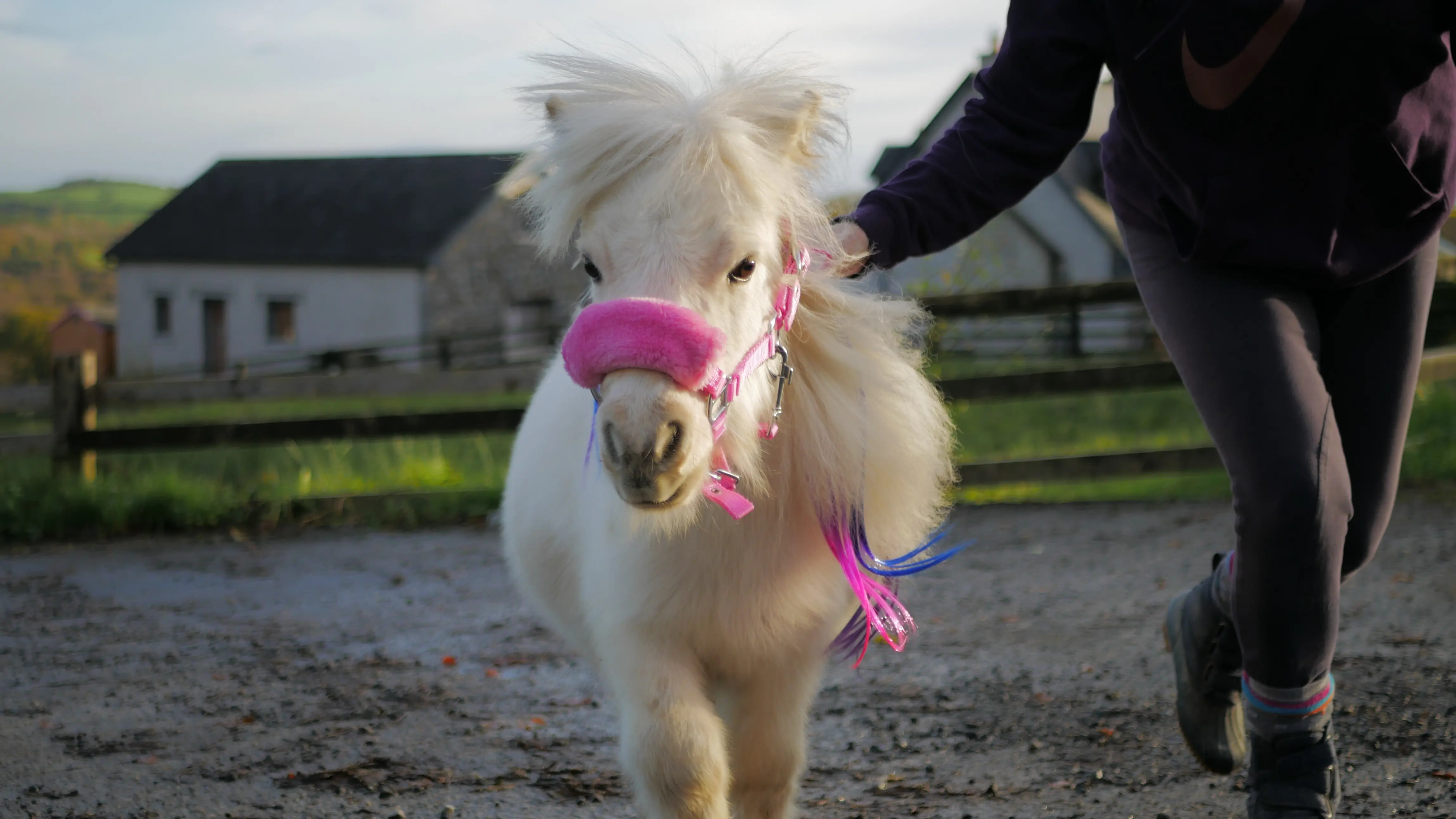
Sessions are always one-to-one, and they follow the child’s lead entirely. Some days that might mean spending an entire session simply standing beside a horse, hand on its side, feeling the warmth and the breathing. Other days it might mean grooming, where the repetitive brush strokes provide rhythmic proprioceptive input. Other days it might mean walking slowly around the yard with a horse, the movement providing vestibular stimulation that helps organise the child’s sensory system.
There’s no fixed programme and no pressure to achieve specific outcomes in any given session. Majella reads each child’s state when they arrive and adapts accordingly. If a child comes in overstimulated and overwhelmed, the session stays quiet, slow, and minimal. If a child comes in under-stimulated and seeking input, the session can be more active — grooming, leading, carrying equipment, being physically engaged with the horses and the yard environment.
The Yard as a Sensory Environment
One of the reasons equine settings work so well for children with sensory processing difficulties is the environment itself. Unlike a clinic or a school, the yard offers a sensory landscape that’s rich but not overwhelming:
Natural light instead of fluorescent. For children who are light-sensitive, being outdoors removes one of the most common triggers. Natural daylight is softer, more diffuse, and doesn’t carry the flicker that fluorescent lights do.
Open space. The yard isn’t enclosed or crowded. There’s room to move, room to step back, room to find the distance that feels right. For children who feel trapped or overwhelmed in small rooms, the openness of the yard is immediately regulating.
Natural sounds. Birds, wind, horses moving and breathing, the rustle of straw — these are sounds the human nervous system has evolved to find calming. They’re unpredictable enough to be interesting without being jarring, and they’re a world away from the beeping, buzzing, and chatter of indoor environments.
Varied textures. Hay, horse coat, leather, rope, grass, gravel — the yard is full of different textures to explore. For sensory-seeking children, this provides the tactile input they need. For sensory-avoidant children, they can choose which textures they engage with and which they don’t. There’s no one forcing them to touch anything.
Purposeful movement. Walking, carrying, lifting, brushing, leading — every movement in the yard has a purpose and a result. This is fundamentally different from the kind of movement a child might be offered in a sensory room, where equipment is designed for sensory input but doesn’t necessarily connect to a meaningful task. Carrying a bucket of water to a horse gives the child heavy work input and a reason for doing it. That combination of sensory input plus purpose is deeply organising for the nervous system.
How This Helps Beyond the Yard
Parents often ask whether the benefits of equine sessions transfer into daily life. The honest answer is: it depends on the child, and it takes time. But what we see consistently is that children who attend regular sessions begin to develop a better understanding of their own sensory needs and a growing ability to self-regulate.
A child who has learned through experience that slow, deep breathing calms a horse — and calms themselves in the process — starts to use that strategy in other settings. A child who has discovered that rhythmic grooming helps them feel settled might seek out similar rhythmic activities at home or school. A child who has found that being near a calm, warm body brings their own nervous system down starts to recognise what they need when they’re becoming overwhelmed.
None of this is taught through instruction. It’s absorbed through repeated, embodied experience. And that’s exactly how children with sensory processing difficulties learn best — not by being told what to do, but by discovering it in their own body, at their own pace, in a setting that feels safe.
If Your Child Has Sensory Processing Difficulties
We work with children across a wide range of sensory profiles — from those who are highly sensitive and easily overwhelmed to those who are sensory-seeking and need more input to feel regulated. Many of the children who come to SJ Equine Coaching have autism, ADHD, anxiety, or a combination, and most have found that standard environments struggle to meet their sensory needs.
Our yard in Kilmore, Co. Clare, offers a calm, natural environment where your child can interact with our horses at their own pace. Sessions are led by Majella Moloney, whose background as a special needs assistant and qualified Equimotional Wellbeing Coach means she understands sensory processing from both a professional and practical standpoint.
We work with families from across Clare, Limerick, Ennis, Shannon, Sixmilebridge, Killaloe, and the wider Mid-West region. If you’d like to talk about your child and whether Equimotional Wellbeing Coaching might suit them, reach out to Majella. No referral is needed, and there’s no obligation. Just a conversation to see if this is the right fit.
Frequently Asked Question
