


- Editor

- CategoryEquine Assisted Activities (EAA)
- DateFebruary 26, 2026
- Share
Children with ADHD often thrive in environments that offer movement, sensory engagement, and immediate feedback. Equine Assisted Activities provide exactly that. Learn how ground-based work with horses at SJ Equine Coaching in Cloonlara, Co. Clare helps children with ADHD develop focus, impulse control, and emotional regulation.
Why Traditional Settings Can Be Tough for Children with ADHD
If you’re the parent of a child with ADHD, you’ve probably lost count of the number of times someone has told your child to sit still, pay attention, or stop fidgeting. The school environment, with its long stretches of seated work, quiet expectations, and rigid timetables, is designed for a type of learner that your child simply isn’t. That doesn’t mean there’s anything wrong with your child. It means the environment doesn’t suit them.
Children with ADHD typically need more movement, more sensory input, more variety, and more immediate feedback than a classroom can provide. When those needs aren’t met, the result is often frustration, behavioural difficulties, and a growing sense in the child that they’re somehow failing — even though they’re not. They’re just wired differently, and they need an environment that works with that wiring rather than against it.
That’s where Equine Assisted Activities come in.
What Are Equine Assisted Activities?
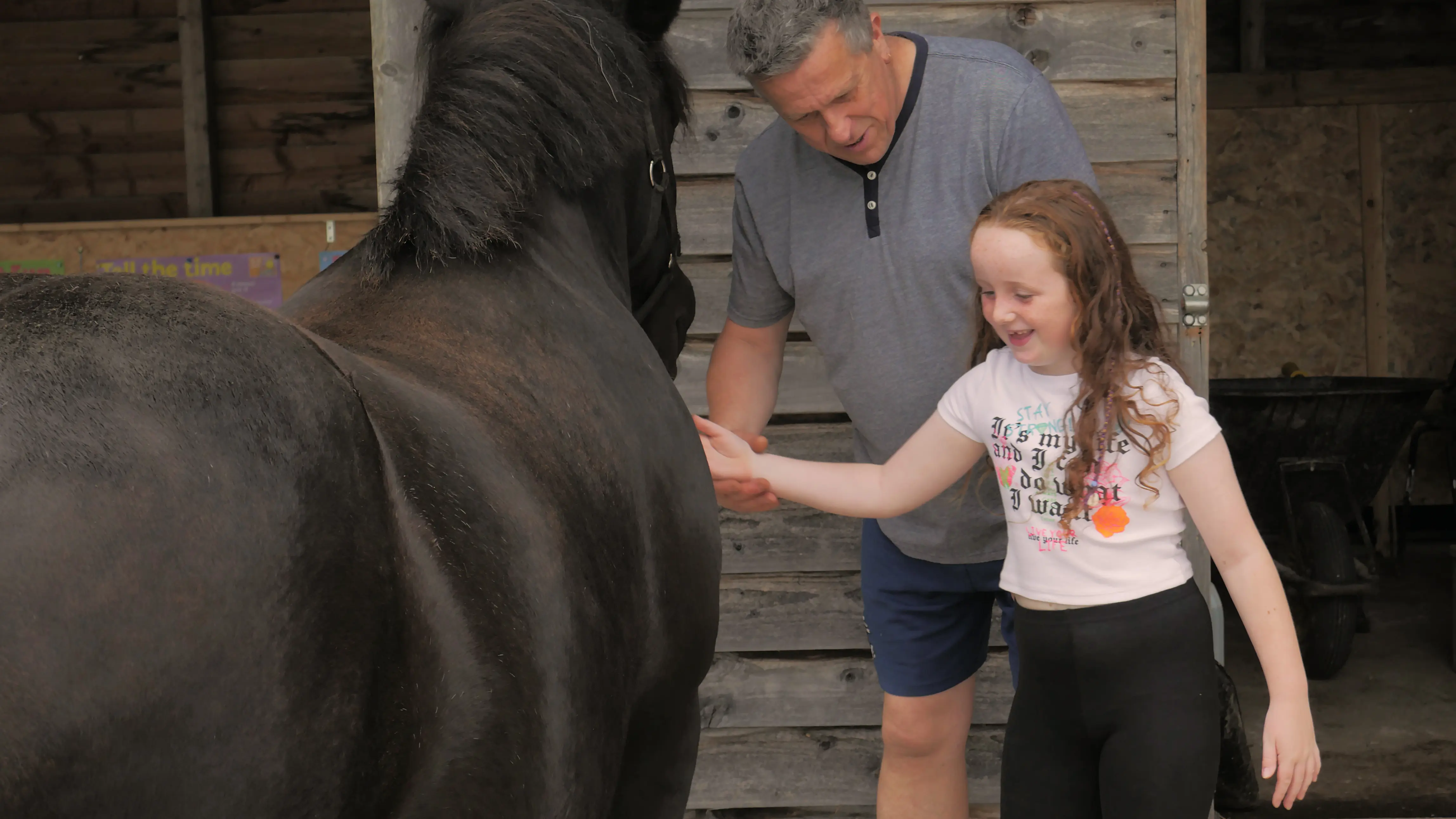
Equine Assisted Activities, or EAA, is an umbrella term for any structured activity involving horses that’s designed to promote personal development, wellbeing, or skill-building. At SJ Equine Coaching in Cloonlara, Co. Clare, our EAA sessions are entirely ground-based — no riding is required, though it can be offered if the child is interested and ready. Sessions are always one-to-one with Majella Moloney, who tailors every activity to the individual child.
For children with ADHD specifically, EAA works because it provides the exact combination of elements their brains are looking for: physical movement, sensory richness, novelty, immediate cause-and-effect feedback, and a genuine reason to focus.
How Horses Naturally Support Focus in Children with ADHD
One of the most common misconceptions about ADHD is that children with it can’t focus. That’s not accurate. Children with ADHD can focus intensely — the difficulty is regulating where that focus goes and sustaining it on things that don’t naturally engage them. The technical term is executive function difficulty, and it affects attention, impulse control, working memory, and planning.
Horses engage children with ADHD in ways that most structured activities simply can’t, and here’s why:
Horses demand present-moment attention. A horse is a living, breathing, 500-kilogram animal with its own moods and reactions. You can’t zone out around a horse the way you might zone out in a maths lesson. If a child’s attention drifts while they’re leading a horse, the horse might stop, wander off, or turn a different direction. That immediate, real-world consequence is exactly the kind of feedback that captures and holds the attention of a child with ADHD. It’s not a teacher’s voice saying “pay attention” for the twentieth time. It’s a horse physically responding to their level of focus.
Movement is built into every session. There’s no sitting still in the yard. Children are walking, grooming, carrying buckets, navigating obstacles, and physically interacting with the horses throughout the session. This constant movement satisfies the proprioceptive and vestibular needs that children with ADHD have, allowing their brains to settle into a regulated state where focused attention becomes possible. Research consistently shows that physical activity improves executive function in children with ADHD, and equine activities provide sustained, purposeful movement rather than aimless energy expenditure.
Sensory input is rich and varied. The yard is a multi-sensory environment. The feel of a horse’s coat under their hands, the smell of hay and fresh air, the sounds of hooves and breathing, the visual stimulation of being outdoors with animals — all of this provides the sensory input that children with ADHD often seek. When sensory needs are met, the brain is less likely to seek stimulation through hyperactivity or impulsive behaviour.
Tasks have clear beginnings, middles, and ends. Grooming a horse has a sequence: you start at the neck, work down the body, pick out the hooves, check the mane and tail. Leading a horse through an obstacle course has a route with a start and a finish. Feeding involves measuring, carrying, and placing. For children who struggle with open-ended tasks or long-term goals, these short, completable activities with visible outcomes provide a structure that makes sense to their brains without feeling restrictive.
Building Self-Regulation Through the Horse’s Response
Self-regulation — the ability to manage your own emotions, impulses, and energy levels — is one of the biggest challenges for children with ADHD. In a classroom, a child might be told to “calm down” without any understanding of what that actually means or how to do it. With a horse, the learning happens naturally.
Horses are mirrors. If a child approaches a horse with frantic, high energy, the horse will become unsettled. It might step back, raise its head, or refuse to cooperate. Not because it’s being difficult, but because it’s responding honestly to the energy being directed at it. If the child slows down, takes a breath, and approaches with calmer energy, the horse visibly relaxes and becomes willing to engage.
This is real-time biofeedback. The child doesn’t need anyone to explain what self-regulation is. They can see it happening right in front of them. When they’re dysregulated, the horse shows them. When they regulate, the horse shows them that too. Over weeks and months of sessions, children internalise this. They start to notice their own energy levels and develop the ability to adjust them — not because an adult told them to, but because they learned through direct experience with an animal who gave them honest, immediate feedback every single time.
Impulse Control Without Punishment
Impulsivity is a hallmark of ADHD, and it’s the one that gets children into trouble most often. Acting before thinking, blurting out, grabbing things, running off — all of these are executive function difficulties, not deliberate misbehaviour. But they’re often treated as behavioural problems, which erodes the child’s self-esteem over time.
Working with horses teaches impulse control through natural consequences rather than punishment. If a child moves too quickly near a horse, the horse steps away. If they grab at the lead rope impulsively, the horse resists. If they try to rush through an obstacle course, the horse won’t follow. None of these are punishments. They’re simply the natural result of the child’s actions, delivered without any emotional charge from an adult.
This matters enormously for children with ADHD who have spent years being corrected, reprimanded, and disciplined for behaviours they struggle to control. At the yard, there’s no telling off. The horse provides the feedback, and the child learns to adjust. And because they’re motivated by their relationship with the horse, they want to adjust. That intrinsic motivation is far more powerful than any external consequence.
What Families in Limerick Tell Us
Parents often come to us after a string of difficult school meetings, behavioural reports, and interventions that haven’t quite landed. Their children are labelled as “disruptive” or “challenging” in settings that were never designed to support them in the first place.
What we hear again and again is that the yard is the one place their child doesn’t get into trouble. They’re not being asked to do things that go against their neurology. They’re being given tasks that align with how their brain works — active, engaging, sensory-rich, and immediately rewarding. For many of these children, it’s the first time they’ve experienced success in a structured activity without someone correcting them.
We’re based in Cloonlara, Co. Clare, and work with families from across Clare, Limerick, Ennis, Shannon, and surrounding areas. If your child has ADHD and you’re looking for something that meets them where they are rather than asking them to be something they’re not, get in touch with Majella for a chat. There’s no referral needed and no pressure. Just a conversation about what might help.
Frequently Asked Question
