Understanding Apraxia of Speech
Childhood Apraxia of Speech (CAS) is a motor speech disorder where the brain struggles to coordinate the movements needed to form words. It's not that a child doesn't know what they want to say, the signals between the brain and the muscles used for speech just don't connect the way they should. Children with apraxia often understand far more than they can express, which can lead to frustration, withdrawal, and a loss of confidence over time.
For parents, it's exhausting. You can see your child trying. You know the words are in there somewhere. But traditional speech and language therapy can feel like an uphill battle when a child is already anxious about being put on the spot.
That's exactly where this family was when they first contacted us.
When they came to us
James's parents had been through rounds of speech and language therapy. There had been some progress with motor planning exercises, but [Name] was still non-verbal in everyday situations. The clinical setting was adding to his anxiety rather than easing it. Being asked to repeat sounds, form words, and perform under observation was overwhelming for him.
They weren't looking for a replacement for speech therapy. They were looking for something alongside it. Somewhere [Name] could feel comfortable, build confidence, and not be defined by what he couldn't do.
Majella's approach
From the very first session, the approach was simple: no agenda, no targets, no pressure to speak.
Majella's background as an SNA means she understands how children with additional needs communicate, through body language, eye contact, gesture, and behaviour. With apraxia specifically, she knew that putting any expectation on verbal output would only increase anxiety and make speech less likely, not more.
Here's what sessions actually looked like:
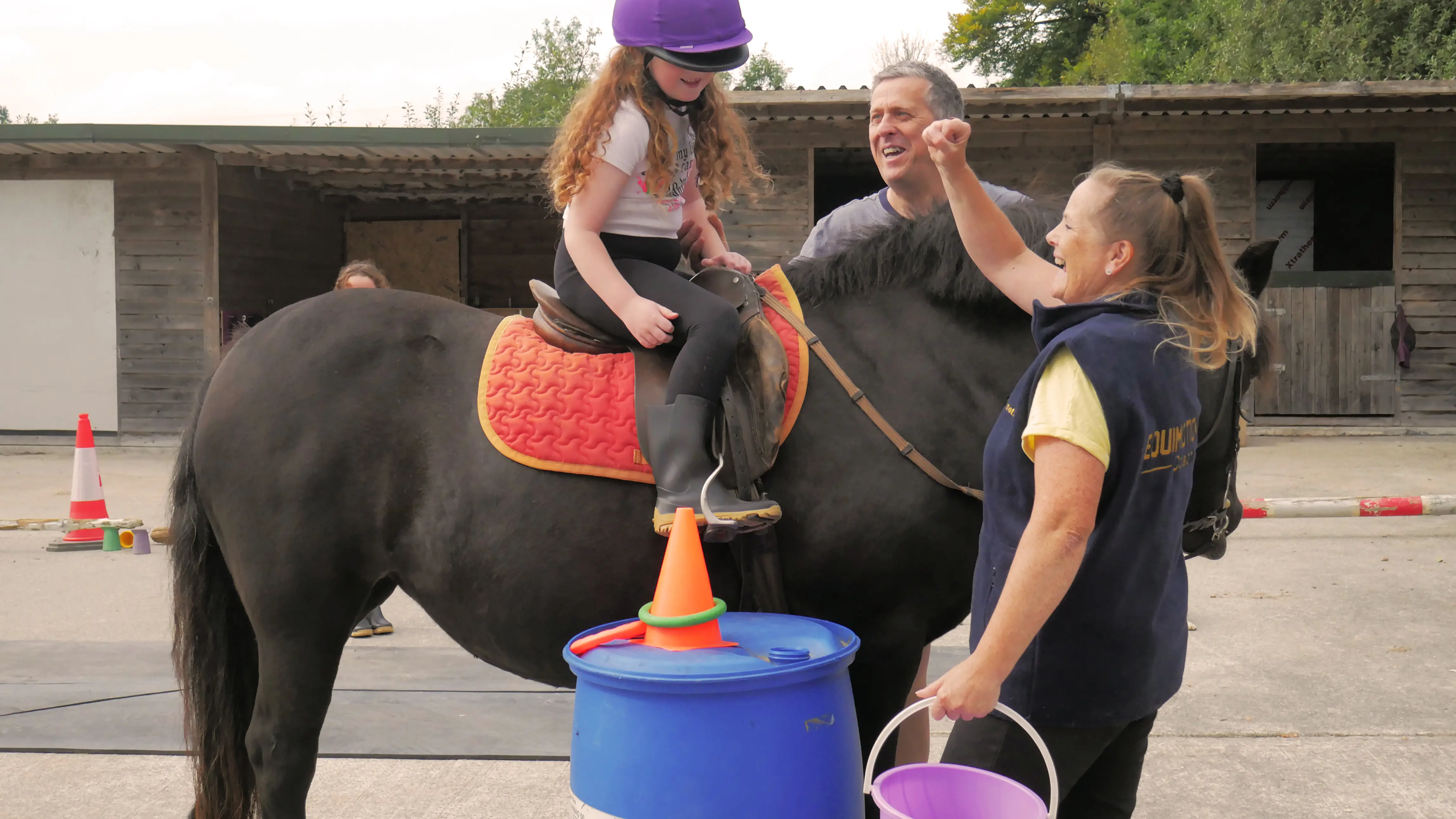
Weeks 1–3: Observation and familiarisation. James spent time in the yard watching the horses from a distance. Majella stayed nearby but didn't direct the session. She let him set the pace, how close he got, how long he stayed, what he touched. The horses were calm and unhurried, which matched the energy he needed. There was no instruction, no "try this" or "come over here." Just space.
Weeks 4–6: Gentle engagement. James began to approach the horses on his own. Majella introduced basic grooming, brushing, picking out hooves, which gave him a physical task that required focus and coordination, but no verbal communication. These fine motor activities also work alongside the motor planning skills that children with apraxia are developing in speech therapy, reinforcing those neural pathways through a different channel.
Weeks 7–12: Building routine and confidence. James started to initiate activities himself. He'd pick up a brush without being asked, walk towards a specific horse, or gesture to indicate what he wanted to do next. Non-verbal communication was becoming more intentional and confident. He was making choices, expressing preferences, and engaging on his own terms. Majella responded to every cue, reinforcing that he was being heard — even without words.
Months 4–6: Connection and trust. By this stage, James had a clear bond with the horses. He was relaxed in the yard, comfortable with Majella, and showing a level of confidence his parents hadn't seen before. He was laughing, smiling, leading the horses around the yard. The anxiety that had been so present in clinical settings was simply not there.
The breakthrough
After months of patient, unhurried sessions, James leaned in close to Majella and whispered a word into her ear.
His dog's name.
His first word.
Majella didn't react. This is critical with children who have speech anxiety — any sudden attention, even positive, can trigger a shutdown. She kept everything calm, carried on as normal, and let the moment belong entirely to him.
But that whispered word was the product of months of groundwork. The reduced anxiety. The sensory regulation from being outdoors with animals. The trust built through consistent, pressure-free sessions. The motor planning practice through grooming and leading. All of it created the conditions where speech became possible — not because he was asked to speak, but because he felt safe enough to try.
Why equine-assisted sessions work alongside speech therapy for apraxia
Children with Childhood Apraxia of Speech benefit from environments that reduce performance anxiety while still engaging the motor planning systems involved in speech. Here's why the yard works:
Sensory regulation: The outdoor environment, the rhythmic movement of grooming, and the calming presence of horses all help regulate a child's nervous system. When a child is dysregulated or anxious, the brain prioritises survival over complex motor tasks like speech. A calm child is a child whose brain is more available for motor planning.
Non-verbal communication practice: Horses respond to body language, energy, and intention — not words. This gives children a way to communicate successfully without speech, which builds confidence and reduces the association between communication and failure.
Motor coordination through physical tasks: Grooming, leading, and caring for horses involve bilateral coordination, sequencing, and fine motor control. These are the same types of motor planning skills being developed in speech therapy, practised in a context that feels like play rather than work.
Intrinsic motivation: A child who is motivated by the horses will naturally attempt more — more movement, more interaction, more communication. This internal drive is far more powerful than external prompts or rewards in a clinical setting.
Reduced performance pressure: There is no audience in the yard. No therapist with a checklist. No parent watching through a window. The child is simply with the horses, and that freedom removes the performance anxiety that can be the biggest barrier to progress for children with apraxia.
What James's parents said
His parents describe the sessions as the thing that "unlocked" something in their son. Not because the horses taught him to speak, his speech therapy continued alongside our sessions, but because the yard gave him a place where he wasn't "the child who can't talk." He was just a boy who was good with horses. And from that confidence, everything else started to follow.
If your child has apraxia of speech or is non-verbal
We work with children across a range of speech and communication needs, including Childhood Apraxia of Speech, selective mutism, speech and language delay, and children who are non-verbal or have limited verbal communication.
Sessions are always 1-on-1 with Majella and tailored entirely to your child. There's never any pressure to speak, participate, or "perform." We follow your child's lead and let the horses do what they do best.
We're based in Cloonlara, Co. Clare, and work with families from across Limerick, Clare, and surrounding areas. If you'd like to have a chat about whether this might suit your child, get in touch.