Finding Calm When Everything Feels Too Much
Understanding childhood anxiety and social withdrawal
Anxiety in children doesn't always look the way adults expect. It's not always obvious fear or crying. Sometimes it's a child who goes rigid around other people. A child who won't join in at birthday parties, who clings at the school gate, who seems permanently tense, even at home, even around family. Their body is stuck in fight-or-flight mode and they don't know how to switch it off.
Social withdrawal often follows. When everything feels overwhelming, the easiest solution is to pull away from people entirely. The child stops trying to join in. They avoid eye contact, resist group activities, and retreat into themselves. Parents watch it happen and feel helpless because the harder you push, the further they pull back.
This is exactly what Aoife's mam, Sinéad, was dealing with when she first rang us.
When they came to us
Sinéad described Aoife as a child who was permanently on edge. She couldn't relax — not at home, not at school, not around friends or family. There was a constant tension in her body and she struggled to engage with anyone outside her immediate family. School was particularly difficult. She wouldn't put her hand up, wouldn't join group work, and spent break times on her own.
They'd tried talk therapy. It made things worse. Sitting in a room with an adult, being asked to name her feelings and talk about what was worrying her, was the opposite of what Aoife needed. She didn't have the words for what she was feeling, and being asked to find them only added another layer of pressure.
Sinéad wasn't looking for another clinical intervention. She was looking for somewhere Aoife could just be, without expectations, without performance, without being watched and assessed.
Majella's approach
Majella recognised immediately that Aoife needed space, not structure. A child in a constant state of anxiety has a nervous system that's working overtime. Their brain is scanning for threats, their muscles are tense, their breathing is shallow. Before any progress can happen, socially, emotionally, or otherwise, the nervous system needs to come down.
That's what the horses are uniquely good at.
Here's how the sessions progressed:
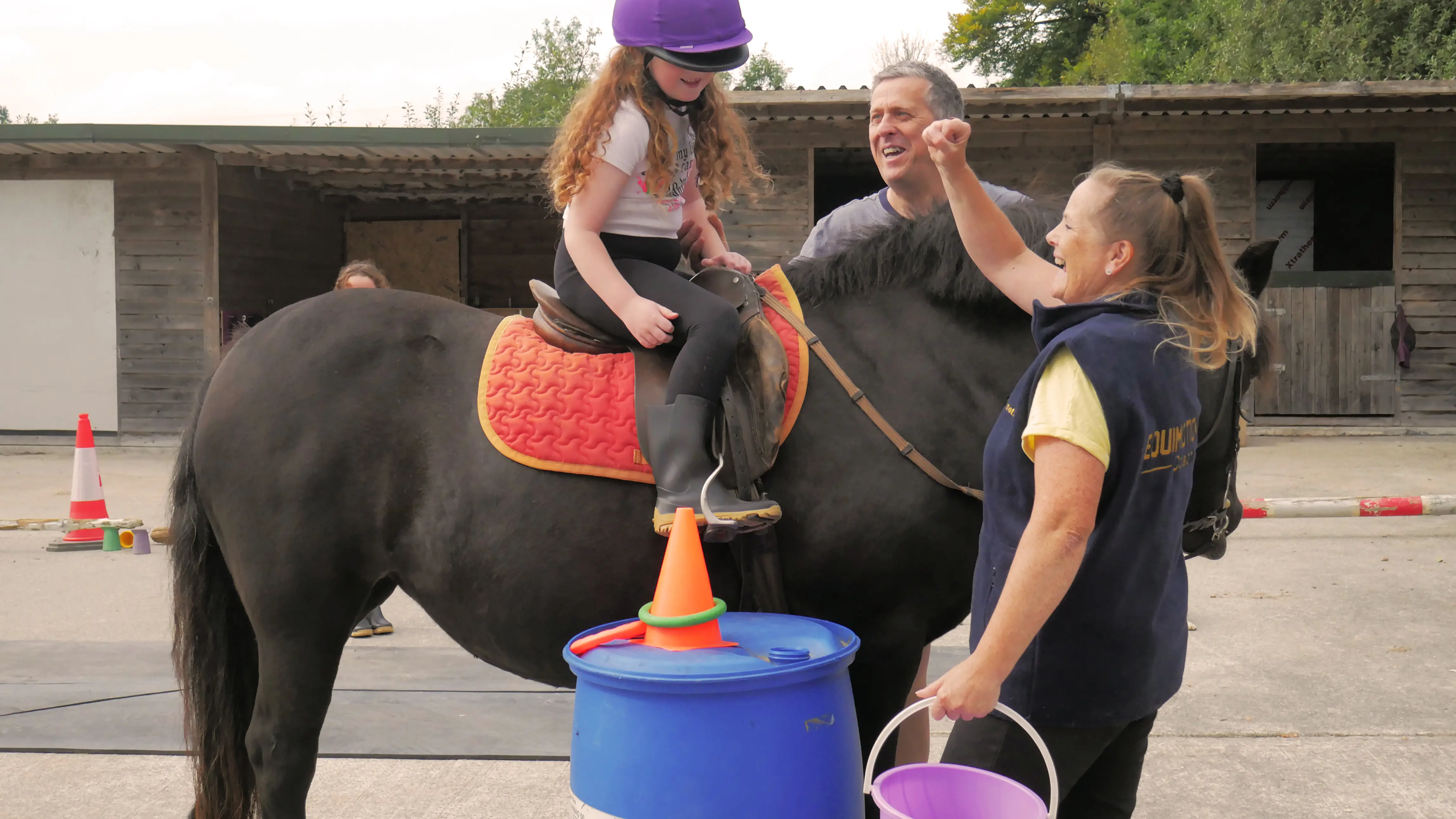
Weeks 1–2: Just being in the space. Aoife came to the yard and Majella didn't ask her to do anything. No introductions with the horses, no tasks, no goals for the session. They walked around the yard together. Majella pointed things out casually — what the horses were doing, who was eating, who was sleeping. She talked to Aoife the way you'd talk to a child who happened to be walking beside you, not the way a therapist talks to a client. The yard itself was doing the early work: fresh air, open space, the slow rhythm of the horses. Aoife's body started to adjust to an environment that wasn't asking anything of her.
Weeks 3–4: Observation from a safe distance. Aoife started watching the horses with genuine interest. Majella introduced her to Socks from a distance, not "come and meet Socks," but more "see what Socks is doing over there." Aoife could watch without any pressure to approach or interact. Horses are prey animals, which means their body language is constant and readable — ears forward means interested, head down means relaxed, shifting weight means unsettled. Without realising it, Aoife was learning to read another living being's emotions through their body language. This is a skill that anxious children often struggle with in human interaction, but find far easier with animals because there's no social consequence if they get it wrong.
Weeks 5–8: First contact and grooming. When Aoife was ready — and it was entirely her decision — she approached Socks. Majella showed her how to groom: long, slow brush strokes, starting at the neck and working down the body. Grooming is rhythmic and repetitive, which has a natural calming effect on the nervous system. It also requires Aoife to match her energy to the horse's. If she's tense or fast, Socks responds to that. If she slows down, breathes, and softens her movements, Socks relaxes too. This is real-time biofeedback without any technology, any wires, or any clinical setup. The horse is the feedback. Aoife was learning to regulate her own body without being told to "take a deep breath" or "calm down."
Weeks 9–12: Leading and building confidence. Majella introduced leading exercises with Socks. This is where things shifted. Leading a horse requires a child to be present, intentional, and clear. You have to walk with purpose, hold the lead rope with confidence, and make decisions about where you're going. For a child who had spent months shrinking away from any form of assertiveness, this was significant. But because the "audience" was a horse — not a classroom of children or a therapist with a notebook — the pressure was gone. Aoife started making decisions. She chose which direction to walk. She learned to stop Socks, turn her, guide her around obstacles. Every successful lead was a small act of confidence that Aoife could feel in her body, not just hear as praise from an adult.
Months 4–6: Transformation. By this stage, Aoife was a different child at the yard. She arrived smiling, went straight to Socks, and took initiative in sessions without waiting for permission. She was making eye contact with Majella, laughing, chatting about her week. The tension that had been so visible in her body, the stiff shoulders, the shallow breathing, the avoidance of eye contact — had softened. She looked like a child who was comfortable in her own skin.
Why equine-assisted sessions work for childhood anxiety and social withdrawal
Children with anxiety often struggle in traditional therapeutic settings because those settings, by their nature, involve scrutiny. Someone is watching, listening, assessing. For a child whose core difficulty is feeling safe around other people, that dynamic can reinforce the problem rather than solve it.
The yard removes that dynamic entirely. Here's why it works:
Co-regulation with the horse. Horses are highly attuned to the emotional state of whoever is near them. A tense, anxious child will notice the horse responding. shifting away, raising its head, becoming alert. When the child calms, the horse calms. This creates a feedback loop where the child learns, through direct experience rather than instruction, that their emotional state affects the world around them and that they have the ability to change it.
Sensory regulation through the environment. Anxiety is as much a physical experience as an emotional one. The outdoor setting, open space, natural light, fresh air, the sounds and smells of the yard, works on the sensory system in ways a therapy room cannot. The rhythmic, physical activities of grooming, feeding, and leading provide proprioceptive and vestibular input that helps regulate an overstimulated nervous system.
Non-verbal success. For children who withdraw because they feel they can't get social interaction "right," horses offer a relationship that doesn't depend on words, social cues, or getting things perfect. The child can connect, communicate, and succeed without ever speaking. This builds a foundation of social confidence that, over time, transfers to human relationships.
Gradual exposure on the child's terms. The progression from watching, to touching, to grooming, to leading mirrors the principles of graded exposure that are used in anxiety treatment — but without any clinical framing. The child doesn't know they're doing exposure therapy. They're just spending time with a horse, doing a bit more each week because they want to, not because someone told them to.
Autonomy and control. Anxiety often stems from a feeling of having no control. At the yard, Aoife made her own choices — when to approach, how close to get, what to do, when to stop. That sense of agency is the opposite of what anxiety creates, and rebuilding it in a safe environment is one of the most powerful things we can do for an anxious child.
What Sinéad said
Sinéad noticed changes at home within the first month. Aoife was sleeping better, her body was less tense, and she was more willing to try things that would previously have triggered a meltdown. By three months, school had flagged improvements too — she was contributing in class, joining group activities, and spending break times with other children for the first time.
Sinéad describes Majella as patient, intuitive, and genuinely caring. She says the biggest thing was that Aoife was never pushed. "Majella read her perfectly from the first session. She knew when to step in and when to just let her be. I've never seen anyone work with my daughter like that."
Sinéad recommends SJ Equine to any parent who has a child struggling with anxiety, social withdrawal, or who simply isn't coping in traditional settings. "If you've tried everything and nothing is clicking, try this. It's not what you'd expect, but it works."
If your child is struggling with anxiety or social withdrawal
We work with children who experience anxiety, social withdrawal, selective mutism, emotional regulation difficulties, and sensory processing challenges. Many of the families who come to us have already tried other approaches — some of which helped, some of which didn't — and are looking for something different.
Sessions are always 1-on-1 with Majella. There are no groups, no audience, and no pressure to talk or participate. We follow your child's lead entirely and work at whatever pace suits them.
We're based in Cloonlara, Co. Clare, and work with families from across Limerick, Clare, and surrounding areas. If you'd like to have a chat about whether this might be right for your child, get in touch